Slip and Fall Accidents in Texas: Proving Negligence and Premises Liability in 2026
As you stroll through a grocery store, a hotel lobby, or an apartment building, everything appears ordinary until suddenly, your feet slip out from under you in an instant. You collide with the hard floor with a disturbing thud, feeling immediate and intense pain in your hip or wrist. Struggling to get back on your feet, you spot a clear liquid on the tiles or a sharp edge of carpet without any warning signs. Although feeling embarrassed is natural, it’s important to remember that the injury you sustained could have been completely avoided.
In the year 2026, cases of Slip and Fall incidents in Texas, legally referred to as Premises Liability, stand out as fiercely contested battles within the civil justice system. Business proprietors and insurance firms excel at shifting blame onto the victim, asserting that you were “not paying attention to your surroundings.” However, the law contradicts this claim. Property owners are legally obligated to maintain a safe environment for visitors. This article will simplify the intricate concept of the “Standard of Care” in Texas, explain how to demonstrate the owner’s awareness of the hazard, and outline the necessary actions to ensure a just settlement. Ultimately, the failure of a business to clean up a spill should not result in jeopardizing your physical well-being and financial security.
The Three Categories of Visitors: Who Does the Law Protect?
In Texas, the rights you have following a slip and fall incident are largely determined by the reason for your presence on the premises. Visitors are categorized into three groups under the law, and the level of care owed to you by the owner varies for each category. Identifying your classification is the initial step in pursuing your legal claim.
The most extensive protection is afforded to Invitees, who are individuals on the property for the mutual benefit of both parties, such as customers in a store or guests in a hotel. Owners are required to not only address known risks but also conduct regular inspections to uncover hidden dangers for Invitees. If they overlook a longstanding leak, they can be held responsible.
The visitor hierarchy in Texas:
- Invitees: Customers and business guests. The owner has a duty to inspect, warn, and repair.
- Licensees: Social guests visiting for their own purpose. The owner only has a duty to warn of known dangers.
- Trespassers: People on the property without permission. The owner generally only owes a duty not to cause intentional harm.
Practical Tip: Always keep your receipt or a digital record of your visit. This is the simplest way to prove you were an “Invitee” and entitled to the highest level of legal protection.
Proving “Notice”: The Core of Every Slip and Fall Claim
Proving Notice is the main challenge in a premises liability case. Merely demonstrating that an accident occurred due to slipping on a grape or a wet spot is insufficient. It is crucial to establish that the property owner was aware of, or should have been aware of, the dangerous condition. This aspect often becomes the deciding factor in cases where claimants lack a well-thought-out legal approach.
There are two forms of notice we investigate. Actual Notice involves an employee witnessing the hazard or being informed about it but failing to take action. Constructive Notice is more prevalent and suggests that the hazard persisted for so long that a “reasonable” owner would have identified it during a routine inspection. Nowadays, we rely on store surveillance videos and digital cleaning records to pinpoint the exact duration a floor remained hazardous. Ultimately, if a spill is left unattended for 45 minutes, the store is considered negligent.
Evidence used to prove notice:
- Security Footage: Seeing the spill happen and watching employees walk past it.
- Maintenance Logs: Proving that the “hourly” floor check didn’t happen for three hours.
- Witness Testimony: Other customers who saw the hazard before you fell.
- Condition of the Hazard: If a frozen item has completely melted, it proves it was on the floor for a long time.
Warning: Property owners often “lose” or overwrite video footage within days. Your lawyer must send a formal notice to preserve this evidence immediately.

Premises Liability Settlements: What Can You Recover?
| Damage Category | Examples in Slip and Fall | How it Increases Payout |
| Immediate Medical | ER visits, X-rays, and MRIs. | Base value of the economic claim. |
| Future Care | Physical therapy or surgery for a torn ligament. | Proves the long-term impact of the fall. |
| Non-Economic | Chronic pain, inability to walk, or loss of sleep. | Uses a multiplier based on injury severity. |
| Negligent Security | If the “fall” was caused by a broken light leading to an assault. | Can lead to significantly higher corporate liability. |
Comparative Fault: The “Open and Obvious” Defense
Insurance companies in Texas often employ the “Open and Obvious” defense, contending that any hazards like spills or broken steps were so apparent that you were at fault for not avoiding them. According to Texas’s Modified Comparative Fault principle, if they can sway a jury that you bear 51% of the responsibility for your accident, you may not receive any compensation.
However, it is important to note that just because a danger is visible does not necessarily mean it is conspicuous to someone who may be distracted, for instance, by browsing products on a shelf. Retailers invest substantial amounts of money in advertising strategies aimed at capturing your attention towards their merchandise rather than the ground. We utilize the “Human Factors” argument to redirect the blame to the store, asserting that they are accountable for the risk since they introduced the distraction.
Ways they try to blame you:
- “You were looking at your phone.”
- “You were wearing inappropriate shoes.”
- “You walked past a yellow warning sign.” (Even if the sign was 20 feet away!)
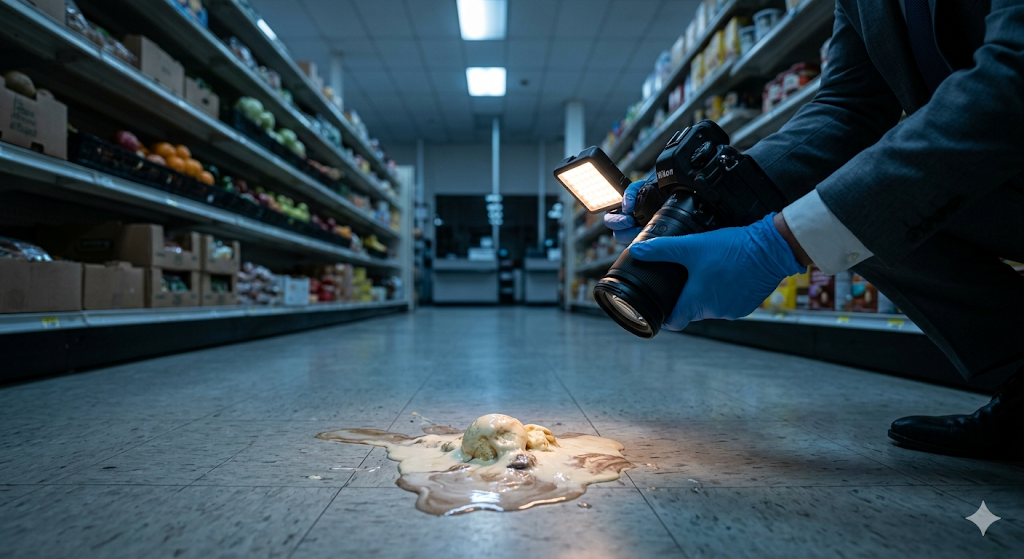
In my experience, photos of the scene from your perspective—at eye level—are the best way to show a jury what you actually saw before you fell.
Common Legal Questions Regarding Property Injuries
What if there was a “Wet Floor” sign near where I fell?
In Texas, simply having a warning sign doesn’t necessarily release the owner from liability. The sign needs to be considered “sufficient.” For instance, if the sign was obstructed by an object or if the wet floor extended far beyond where the sign was placed, the owner might still be held accountable. We evaluate the positioning, clarity, and timing of the warning to determine if it met the required legal level of caution.
Can I sue an apartment complex for a slip and fall?
Certainly. Apartment landlords are obligated to upkeep shared spaces such as staircases, parking areas, and laundry facilities. Frequent complaints involve inadequate lighting in stairwells, damaged railings, or icy surfaces that have not been treated. As a tenant (referred to as an Invitee), the apartment complex is expected to regularly check these areas. For instance, if a persistent leak in a hallway led to your slip and fall incident, the fact that the complex habitually “patches up” issues instead of fully repairing them can be crucial evidence to support your case.
How much is a “typical” slip and fall settlement worth?
The compensation amount for injuries varies based on their seriousness, with no set figure. For instance, a “soft tissue” bruise might result in a settlement around $15,000, whereas a fractured hip or traumatic brain injury (TBI) could lead to a compensation of $250,000 or higher. In 2026, the settlement amount is significantly impacted by your Maximum Medical Improvement (MMI) and whether the injury will result in lasting pain or mobility challenges.
Conclusion
In Texas, if you experience a slip and fall incident, it can transform a routine task into a serious health emergency. It is vital to be aware of the Notice regulations and not take responsibility for a property owner’s carelessness. By doing so, you can ensure that you receive the necessary compensation to aid in your recuperation. Do not allow an insurance adjuster to persuade you that your fall was merely accidental; it was a lack of accountability.
Key Takeaways:
- Identify Your Status: Most customers are “Invitees” with the highest legal protection.
- Prove the Timeline: Evidence must show the owner had time to fix the hazard.
- Fight the Blame: Don’t let “Comparative Fault” erase your right to a settlement.
- Document the Scene: Photos and witness names are more valuable than a store’s internal report.
Focus on your physical therapy and your healing. Let the legal experts handle the complex battle of premises liability. You have a right to a safe environment, and you have a right to justice when that safety is compromised.
IMPORTANT LEGAL DISCLAIMER: This article is intended for educational and informational purposes solely and should not be considered as legal guidance. Regulations differ depending on the state and area. Each incident involving accidents and injuries is distinct. If you have suffered an injury, it is recommended to seek advice from a competent personal injury lawyer in your locality for guidance tailored to your circumstances.